
The Ancient World of The Star Bearers
In the world of The Archangel Chronicles, the Star Bearers move through a civilization poised between glory and collapse:
A world of imperial roads and forgotten deserts, of temples, caravan kingdoms, and ancient prophecies whispered beneath unfamiliar stars. It is a world bound together by the immense reach of the Roman Empire, yet fractured by ambition, conquest, and spiritual longing. Across this vast landscape, merchants, philosophers, kings, soldiers, and mystics travel the great arteries of the ancient world in search of meaning, power, redemption, and light.
At the center of this world stands Alexandria, jewel of Roman Egypt and crossroads of civilization. Here Greek philosophy mingles with Egyptian mystery, Jewish scholarship, Roman power, and the wisdom of distant India. Its towering lighthouse watches over a harbour crowded with ships from every known land, while within the shadowed halls of its libraries and academies, physicians, astronomers, scribes, and seekers wrestle with the deepest questions of existence. It is in Alexandria that Adam Anyone first learns that knowledge alone cannot heal the wounds of the human soul.


Beyond Alexandria stretches Roman Egypt, a land of fertile Nile waters and endless desert silence. Ancient temples still stand half-buried in sand, guarded by priests who remember older gods, while Roman officials govern from marble villas built beside monuments already ancient when Caesar was born. Along the Nile, life flourishes beneath the certainty of the river, but beyond the cultivated green lies the wilderness: the sacred desert where prophets, hermits, rebels, and wanderers disappear in search of God.
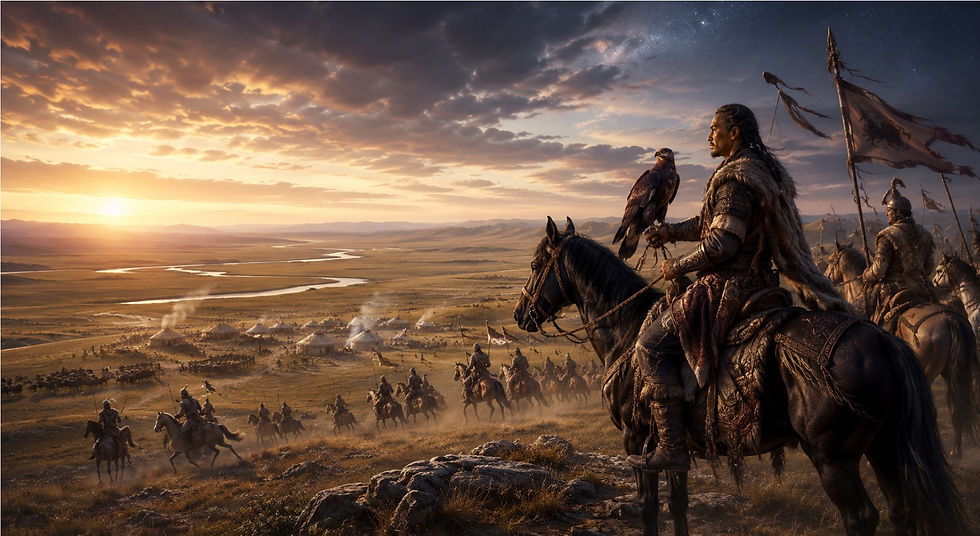
Eastward lie the immense Central Asian Steppes, oceans of grass beneath endless skies. Horse clans ride like storms across the plains, carrying falcons, bows, and ancestral songs. The steppe is a place of fierce freedom and constant motion, where kingdoms vanish like smoke and only strength, loyalty, and courage endure. Here Targitus and the Scythian riders roam beneath the stars, guardians of ancient pathways few civilized men dare to travel.

Hidden among desert roads and caravan trails stands Bukhara, a city of blue domes, sacred fire, and whispered wisdom. Merchants from China, Persia, India, and Greece fill its markets with silk, incense, spices, and stories from the ends of the earth. Yet beneath its wealth lies another treasure: a hidden fellowship of seekers who preserve fragments of forgotten truth passed down through generations.
Nearby lie the ruins and remnants of the lost Greek cities of Bactria, the farthest dream of Alexander’s conquests. Once brilliant outposts of Hellenistic civilization, these cities now stand weathered and isolated beneath desert winds and mountain shadows. Marble statues crumble beside Buddhist monasteries and Persian fortresses, revealing a strange meeting place of East and West where cultures merge into something entirely new. In these forgotten kingdoms, the memory of Alexander still lingers like a ghost.


Southward stretches the Indo-Parthian Kingdom ruled by the wise and troubled King Gondophares. His realm sits at the crossroads of Persia and India, where Greek, Persian, and Indian traditions coexist uneasily beneath royal banners. The kingdom is wealthy from trade yet haunted by political intrigue, spiritual unrest, and the growing awareness that worldly power cannot satisfy the hunger of the soul.
At the heart of this kingdom rises Taxila, one of the greatest learning centres of the ancient world. Philosophers debate beneath colonnades while scholars study astronomy, medicine, mathematics, and sacred texts gathered from distant lands. Greek sculptors carve Buddhist kings in the image of Apollo, and caravans arriving from China pass Roman travellers on crowded stone streets. Taxila is a meeting place of civilizations, a city where wisdom itself seems alive.
Farther south lies Barbaricum, gateway between India and the western seas. Here merchants unload wine and silver while eastern traders carry pepper, silk, ivory, and precious gems toward Arabia and Egypt. Ships vanish beyond the monsoon horizon, and every dockside tavern echoes with a dozen languages. Barbaricum is a city of restless movement, where fortunes are won and lost upon the tides.

To the southwest rises the powerful African kingdom of Kingdom of Aksum, ruled in the chronicles by King Balthazar. Aksum stands upon the highlands above the Red Sea, rich from trade in gold, ivory, frankincense, and exotic treasures carried from the African interior. Great stone stelae rise toward heaven, and ancient traditions blend with a growing awareness of the divine mystery unfolding beyond their borders. In Aksum, kingship is measured not merely by power, but by wisdom, humility, and service.
Northward stretch the red-rock kingdoms of the Nabataean Kingdom, masters of the desert caravan routes. Their hidden cities are carved directly into stone cliffs, glowing crimson beneath the desert sun. Water flows through secret channels beneath the sands, allowing life to flourish where none should exist. Nabataean merchants move like lifeblood across the incense routes, carrying spices, myrrh, silk, and news between empires. Yet their kingdom stands fragile before the growing shadow of Rome.


And finally there is Judea: small, troubled, and fiercely alive with expectation. Beneath the rule of Rome and the paranoia of King Herod the Great, the land trembles with prophecy and unrest. Pilgrims crowd the roads to Jerusalem while rebels hide among the hills and prophets cry out in the wilderness. Roman soldiers patrol ancient streets where priests tend sacrifices in the shadow of the Temple. It is a land filled with sorrow, longing, and hope; a land waiting for redemption.
Across all these realms travel the Star Bearers: kings, healers, warriors, poets, exiles, and seekers drawn together beneath the light of a single star. Their journey carries them through the grandeur of empires and the loneliness of deserts, through courts of power and hidden sanctuaries of faith. The world they inhabit is vast, dangerous, beautiful, and haunted by the sense that history itself is about to change forever.
